
As part of a very busy June this year we tagged on a long overdue visit to Kobelco’s impressive new European headquarters in Lelystad and finds a company that has spent the past decade rebuilding its presence, strengthening its dealer network and looking well beyond the excavator as we know it today. by Brian Coogan
A visit to a manufacturer’s headquarters can sometimes feel like a carefully managed walk through a corporate brochure. Our recent trip to Kobelco Construction Machinery Europe’s new home in Lelystad was different.
The building is impressive, of course, but the more interesting story is what it represents: how far Kobelco has come since returning to the European market under its own name more than a decade ago, and where it intends to go next.

We were warmly welcomed by Xenia Kolijn, General Brand Manager for Kobelco Construction Machinery Europe, together with Michel Wierts, Business Director for Kobelco in Europe.
Between them, they gave us a straightforward presentation on the company’s progress since it re-established its independent European operation in 2013.
There was plenty to talk about: a wider dealer network, a much broader machine offering and a brand that has worked its way back into serious consideration with contractors across Europe, Ireland and the UK included.
A headquarters built for the next chapter
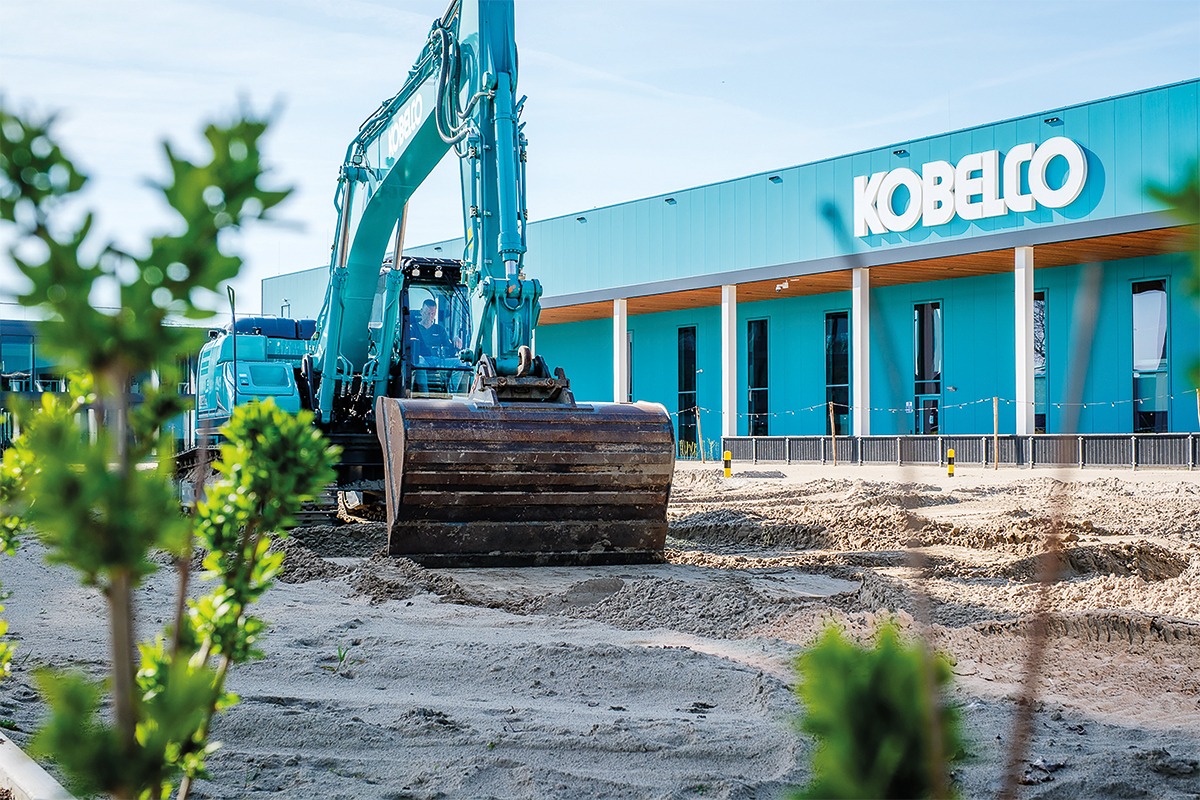
Kobelco’s move from Almere to Lelystad is not simply a change of address. The new headquarters sits on a 17,500m² site and brings the company’s European sales, product support, parts, training and customer demonstration activities together in one modern base.
There is an expanded high-efficiency parts warehouse, technical classrooms, a fully equipped workshop, a showroom and conference facilities. The site also includes a 3,500m² outdoor demonstration area where machines can be put to work properly.
That matters because a strong excavator is only half the argument nowadays. The customer also wants to know where the parts are coming from, who is training the fitters, how quickly a technical question will be answered and whether the dealer has the manufacturer standing behind it.
Lelystad gives Kobelco more room to support that full package and to bring dealers and customers closer to the product. It feels less like a relocation and more like a statement of intent.
“Lelystad feels less like a relocation and more like a statement of intent.”
A decade of rebuilding
When Kobelco returned to Europe as an independent excavator specialist, it had a well-known name and a loyal following, but it still had to rebuild the commercial structure around the product.
Dealer coverage, parts support, technical knowledge and customer confidence do not arrive overnight. The presentation from Xenia and Michel showed that the past ten years have been about putting those foundations back in place, country by country and dealer by dealer.
One thing that has remained consistent throughout Kobelco’s return to Europe is its no-flash, no-fuss approach. There is no great song and dance around the company. It concentrates on building good excavators, supporting its dealers and allowing the machines to prove themselves with customers.
That same attitude seems to run through much of its European dealer network. Since relaunching in Europe more than ten years ago, Kobelco appears to have been very careful about appointing dealers that fit its way of doing business.
They tend to be experienced, practical machinery people who understand their customers and place a strong emphasis on service and backup rather than making exaggerated promises.
It is an approach I like, and it appears to be working extremely well.
The independently verified sales report presented to us during our visit showed Kobelco leading the field in excavator sales across a number of important European categories. These were not simply figures produced for a company presentation; the market information had been independently verified.
The figures perhaps explain why Kobelco does not feel the need to shout too loudly. Its progress can be seen in the number of machines now working across Europe and in the strength of the dealers representing the brand.
Kobelco has taken a steady and measured approach since returning to the European market. It has appointed dealers that suit the company, supported them properly and allowed the reputation of the machines to grow naturally. More than ten years later, the sales figures suggest that this quiet, straightforward strategy has paid off.
“Kobelco’s no-flash, no-fuss approach appears to be working – and the independently verified sales figures back that up.”
The machines gave the company a strong starting point. Kobelco has long been associated with smooth hydraulics, low fuel burn, quiet operation and a particularly strong range of short-radius excavators.
Those qualities suit the Irish and UK markets, where machines are expected to move between housing, utilities, roadwork, civils, demolition and tight urban sites without much fuss.
However, the growth story has not been built on nostalgia. New models, better European support and a willingness to work with specialist technology partners have kept the brand moving forward.
The new facility makes that progress visible. It gives Kobelco the capacity to train dealers more consistently, hold more parts, demonstrate machines in real working conditions and introduce customers to the digital systems that will increasingly sit around the excavator.
That last point is important because the next stage of competition will not be decided by iron alone.
K-DIVE brings the operator out of the danger zone
The most eye-catching part of the visit was K-DIVE, Kobelco’s remote-operation platform.
In simple terms, it allows an excavator to be controlled from a remote cockpit over a communications network. Cameras and machine data give the operator the information needed to work without sitting in the cab, while the wider K-DIVE concept links remote operation with cloud-based job and operator management.
Kobelco describes it as telework for construction, which is probably the clearest way of putting it.
The idea has been under development since 2015 and it is aimed at real problems rather than technology for technology’s sake.
Remote operation can keep people away from unstable demolition work, contaminated ground, disaster recovery and other hazardous environments. It could also allow a skilled operator to work across more than one site without losing hours travelling.
It may open the job to people who cannot spend a full day inside a machine on a rough site but who still possess the skills and experience needed to operate one productively.
There are obvious questions around communications, responsibility, site supervision and how quickly the industry will adopt the system. Kobelco is not pretending that every excavator will be operated from an office next year.
However, K-DIVE has moved well beyond a drawing-board exercise. The system has been demonstrated over long distances, showing how remote operation could become a practical part of future construction and demolition projects.
“This is not technology for the sake of it; the strongest case is taking the operator away from danger.”
Leica and Xwatch complete the picture
Remote control on its own is only one piece of the jobsite. The machine still needs to know where it is, what level it should be working to and where it must not go.
That is where Kobelco’s collaboration with Leica Geosystems and Xwatch Safety Solutions becomes particularly interesting. The three companies are bringing remote operation, machine control and safety awareness together on the same platform.
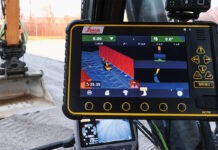
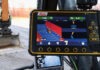
Leica provides the positioning and machine-control side. Its systems can guide the operator against a 2D or 3D design, showing the bucket position and target level in real time.
For contractors, that means less setting out, fewer grade checks, reduced over-dig and a better chance of getting the work right the first time.
Those benefits are already well understood on larger civil engineering schemes, but they become even more important when the operator is working remotely and cannot rely on the usual view from the cab.
Xwatch adds the safety layer. Its technology can define height, slew and depth limits and create protected zones around services, structures or people.
Depending on the installation, the system can warn the operator and restrict machine movement before a limit is breached. In a remote-working setup, that extra electronic boundary is not a nice add-on; it is a key part of making the entire operation practical and accountable.
The collaboration was demonstrated publicly at Bauma, where Kobelco’s K-DIVE remote-operation technology was combined with Leica machine control and Xwatch safety systems.
The significance is not simply that three well-known names have appeared on the same press release. Each company is concentrating on the part it knows best: Kobelco on the excavator and remote controls, Leica on accuracy and digital positioning, and Xwatch on keeping the machine within safe working limits.
For contractors, that joined-up approach could prove important. Machine control and safety systems have often been installed as separate additions after a machine has been purchased. Bringing the manufacturer, machine-control specialist and safety provider together creates the potential for a more integrated package.
It should make the technology easier for dealers to support and, more importantly, simpler for the end user to understand and operate.
More than a new building
For Irish and UK contractors, the immediate value will still come down to familiar things: a good machine, dependable dealer backup, parts on the shelf and technical people who answer the phone.
Kobelco understands that. The investment at Lelystad strengthens those basics while creating space for the next generation of training, machine control and remote-operation support.
Our visit left the impression of a company comfortable with what it has achieved but not inclined to sit back.
Kobelco has rebuilt a credible European business over the past decade, and the new headquarters gives it a stronger platform for the years ahead. K-DIVE, together with the Leica and Xwatch collaboration, shows that its thinking now stretches well beyond the conventional excavator.
The company’s approach remains refreshingly straightforward. There is no unnecessary flash and very little fuss. Kobelco appears happy to concentrate on its machines, work closely with dealers that share the same outlook and allow the results to speak for themselves.
Judging by the independently verified sales figures presented during our visit, those results are now becoming increasingly difficult for the wider industry to ignore.
The blue machines remain at the centre of the story, as they should. But Lelystad makes one thing clear: Kobelco is no longer simply re-establishing itself in Europe. It is building for the next chapter.