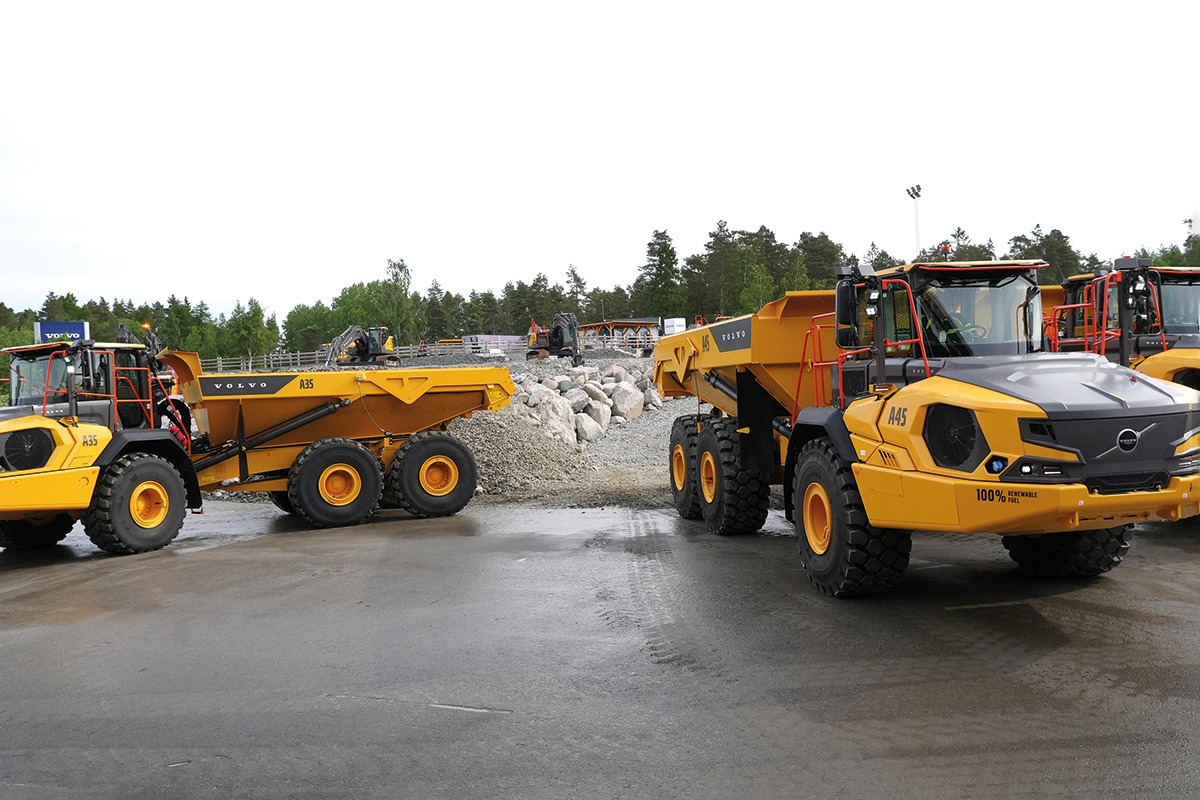
From “Gravel Charlie” to electric haulers and next-generation excavators, Volvo Days 2026 delivered history, high-energy demonstrations and plenty of new iron to experience. By Digger Man Blog’s Nick Drew
The stunning Volvo Construction Equipment Customer Center in Eskilstuna, Sweden, was once again the setting for the latest edition of the manufacturer’s popular Volvo Days event. I joined a distinguished gathering of international trade press journalists and a sprinkling of social media creators for what is undoubtedly one of my favourite events on the machinery circuit calendar.
Volvo Days has been running since 1971, and the 2026 edition—its 55th year—was the biggest yet. Staged over four weeks during June, it welcomed customers, suppliers, dealers, press and other industry guests, who were treated to the spectacle of more than 100 machines working in the demonstration area.
The theme was “Smarter Solutions. Driven by You.” It underlined Volvo CE’s focus on placing customer requirements at the centre of its product development, digital services and complete jobsite solutions.
From my point of view, Volvo CE always delivers a masterclass in how these events should be run. Everything is slick and professional, but conducted in that typically relaxed Swedish way.
That begins from the moment visitors step off the bus. We were greeted by the Volvo team, who formed a clapping guard of honour as we made our way towards the grandstand. It is a surprisingly emotional and humbling way to arrive.
Heavy-metal ballet
Once seated in the grandstand, we were treated to a spectacular demonstration that brought together Volvo’s history and its latest technology.
The opening scenes took us back to the early days of articulated hauler development. Members of the demonstration team appeared in period costume with an original BM-Volvo tractor and trailer, which promptly became bogged down.
Following a discussion with a designer, the original Volvo articulated hauler—affectionately known as “Gravel Charlie”—appeared as the solution to the material-moving problem.
It was a genius opening that demonstrated how new machinery has always emerged from customer and end-user feedback, even in those pioneering days.
“Volvo CE always delivers a masterclass in how a machinery event should be run.”
From there, the pace increased dramatically as Volvo’s latest diesel and electric articulated haulers charged towards the grandstand, criss-crossing with remarkable speed and precision.
It was like a perfectly choreographed heavy-metal ballet—absolutely sensational!
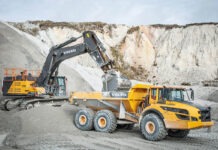
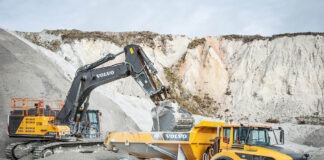
Three haulers tipped loads of stone in the centre of the demonstration ground before the 95-tonne EC950F L excavator came over the ramp and levelled the material to create its own working platform.
Once in position, the excavator was joined by the A60, the largest articulated hauler in Volvo CE’s range. The EC950F L operator placed the bucket into the rear of the A60 while the hauler drove within the excavator’s slew radius, lifting it onto two wheels during the manoeuvre.
I have seen this performance on previous visits, but it remains a show-stopping demonstration. This time, just to add another dimension, the team performed it in reverse as well.
Wheeled loaders, High Lift timber handlers, wheeled excavators and mini excavators also joined the action before the machines gathered for an exhilarating finale.
Investing in European production
Following the excitement outside, we headed to the theatre for a briefing on the latest developments within Volvo CE.
The company confirmed a SEK 9.2 billion European investment programme. This includes SEK 702 million for a new excavator assembly facility in Eskilstuna, which was already well under construction near the customer centre.
The first machine is expected to roll off the production line in 2028. It will be Volvo CE’s first excavator manufacturing facility in Sweden and will have the capacity to produce as many as 3,500 machines annually.
Volvo also discussed its acquisition of dealer Swecon, giving the manufacturer direct control of around 70% of its European retail operations and creating an even closer link between the factory and its customers.
The big machine news was that the A40 Electric articulated hauler had entered serial production alongside the A30 Electric, which made its debut at Bauma in 2025.
European debuts included the ECR255 and ECR355 short-swing crawler excavators. Other notable exhibits included the new ECR90 midi excavator, EC65 crawler excavator, EW65 wheeled excavator, L260 Heavy Duty rehandling loader and the EC560 large crawler excavator.
The EC560 was one machine I was especially keen to get my hands on.
Into the machinery playground
After a hearty lunch, we were let loose in the demonstration area to get up close and personal with the new equipment. It is essentially a giant machinery playground where visitors are encouraged to climb aboard and operate almost any machine they fancy.
The only downside was that we had around three hours before the bus departed for the airport. Another full day in the seat would have been fantastic, but we had to make the most of the time available.
After a quick scout around, I decided to concentrate on two machines at opposite ends of the size scale: the EC560 and ECR90.
The 56-tonne-class EC560 uses a platform similar to the EC530 and EC550E L models we operated during Volvo Days 2024, but has gained additional weight through the installation of a heavier counterweight.
The example at Eskilstuna was one of the first pilot machines made available for customers to operate. With its official European launch planned for 2027, complete technical specifications had not yet been released.
First shown publicly at Conexpo in Las Vegas earlier in 2026, the EC560 will slot between the 55-tonne-class EC550E and 75-tonne-class EC750E.
It has been designed in response to customer demand for a machine combining the strength required for heavy production work with the finesse needed for more precise operations, while still delivering fuel efficiency and renowned Volvo operator comfort.
“The EC560 looks solid in every department and feels every inch the new big boy on the block.”
The machine incorporates an uncomplicated hydraulic hybrid system that captures energy generated during the boom-down movement. That energy is stored in 32-litre hydraulic accumulators and used to drive assist motors supporting the engine, helping to reduce fuel consumption.
It is mind-blowing stuff when you stop and think about it.
Walking around the EC560, it looks solid in every department. Its wide footprint and double-grouser track pads give it a well-balanced appearance. A long undercarriage, three upper carrier rollers and guarding around the lower rollers provide durability for harsh applications such as quarry work.
I particularly like the offside access steps, similar to those fitted to the EC530E and EC550E. They guide the operator safely towards the engine bay while making it easy to maintain three points of contact.
The next-generation cab offers everything we have come to expect from a Volvo excavator: it is well appointed, spacious and extremely comfortable.
The integrated Co-Pilot display provides machine information, camera views and operating settings. The machine also features Volvo’s radar-based People and Object Classification system to improve awareness around the working area.
Electro-hydraulic controls allow the operator to fine-tune functions such as boom and slew speed, boom-down speed and the balance between travel and hydraulic performance.
This is especially useful when loading articulated dump trucks, where production operators want to return the bucket to the ground as quickly as possible on every cycle.
Getting behind the controls
The EC560 uses keyless starting and it was a delight to hear the big six-cylinder Volvo diesel engine purr into life.
Our time in the machine was brief and the demonstration plot offered little more than an opportunity to dig into a heap and cast the material to one side. However, the heavy mixture of rock and soil at Eskilstuna provides a demanding test.
You instantly feel the power and bucket breakout force as the bucket enters the heap. Volvo says digging performance has increased by three per cent compared with the EC550E.
The machine was also surprisingly quick across the slew. Volvo claims a 10% increase in swing torque and, judging by my brief experience, I certainly would not dispute that figure.
It remained superbly balanced throughout the complete slew arc. Even working over the side at full reach with a full bucket produced no obvious stability issues, with the wider footprint and heavier counterweight clearly doing their job.
With other eager operators waiting, I received the signal to leave the cab. Hopefully, we will get a longer opportunity to evaluate the EC560 in the future, but I climbed down thoroughly impressed.
“You instantly feel the EC560’s power and bucket breakout force as it bites into the heap.”
A new nine-tonner arrives
With time running out, I headed across the demonstration area to try the much smaller ECR90.
This long-awaited nine-tonne-class machine replaces the ECR88D, which first appeared in 2015 and received several updates during its lengthy production life.
Almost everything has been increased on the ECR90.
Power comes from a Stage V-compliant Volvo D3.3H 3.3-litre, four-cylinder diesel engine producing 55kW, or 74hp. That represents an impressive 28% increase over the outgoing model, without requiring AdBlue—an attractive benefit for plant-hire and rental fleets.
The side-mounted engine is accessible from ground level through a large gull-wing bonnet, providing excellent access for daily inspections and routine maintenance. Larger diesel and hydraulic tanks are positioned at the rear, adding weight alongside the compact-radius counterweight.
An upgraded hydraulic pump complements the more powerful engine. Volvo reports a 15% increase in breakout force, 11% more arm-digging force and 7% more tractive effort.
Hydraulic flow has increased from 118 to 136 litres per minute, making the ECR90 better suited to demanding attachments such as flail mowers and planers.
Slew performance has also been improved, something that was noticeable when working on an incline and discharging a loaded bucket uphill.
A bigger and better cab
Another major change is the new F-Series cab, which is 30% larger than that fitted to the ECR88D. Its appearance and layout align the ECR90 with Volvo’s larger excavators, while placing considerable emphasis on comfort and visibility.
The machine features keyless starting and an intuitive eight-inch, high-definition touchscreen. Side and rear camera images are shown on the display, with the side-view camera offered as an option.
“Safely home” delayed lighting remains illuminated after shutdown, allowing the operator to walk away from the machine more safely in darkness.
Available options include a two-piece boom, steel tracks and additional counterweight for lifting duties or attachments such as the Steelwrist tiltrotator fitted to the demonstration machine.
I spent around 15 minutes in the ECR90 and was impressed by the spacious cab. The increasingly common electro-hydraulic controls required a little familiarisation and I would have liked more time to master them fully, but that did not detract from a very positive operating experience.
The air conditioning, distributed through no fewer than seven adjustable vents, was especially welcome on a warm Swedish afternoon.
From numerous discussions with loyal Volvo customers, I know many have waited patiently for this new nine-tonne machine. Having finally operated it, I do not think they will be disappointed.
“Volvo customers have waited patiently for this new nine-tonner—and they will not be disappointed.”
Volvo Days 2026 was another exceptional event packed with energy, passion and new machinery technology. It remains a top-drawer date in the industry calendar and one I am always sad to leave.
If only it lasted one more day, giving us more time behind the controls, it would be just about perfect.