‘Today, productivity depends less on individual machines and more on how the whole site works together’
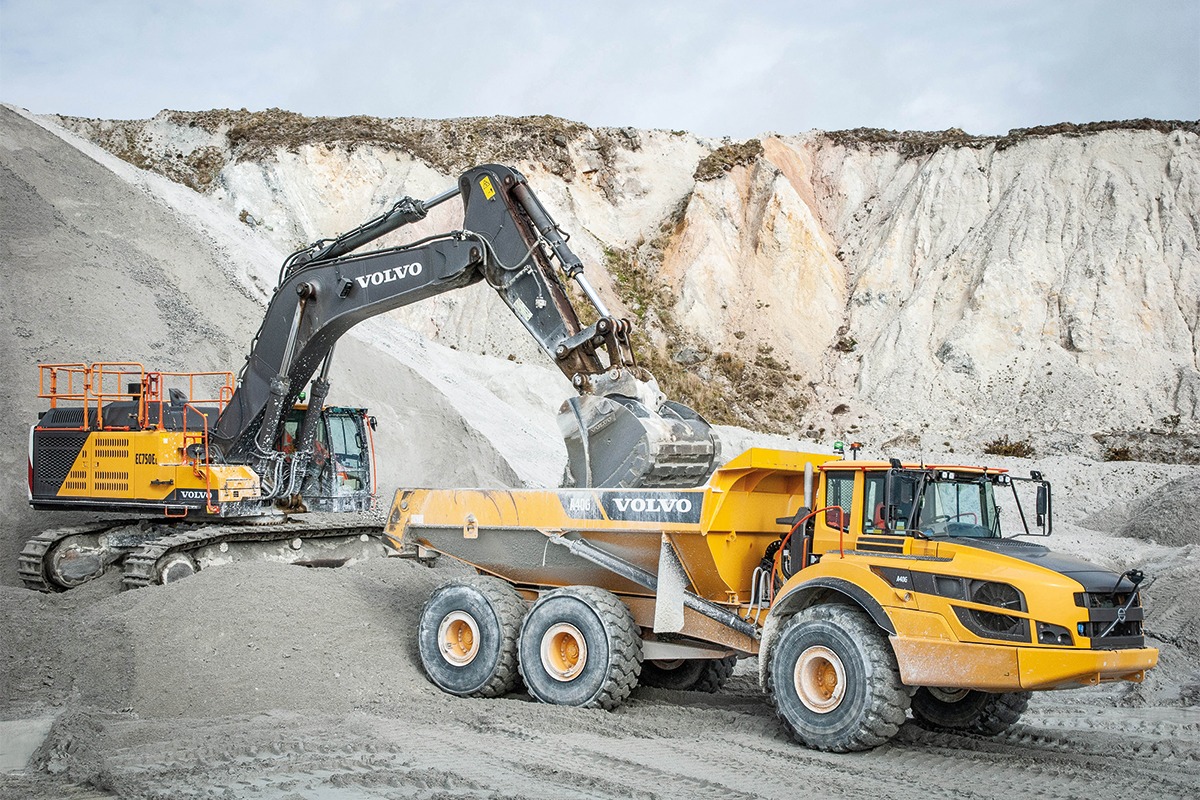
Historically, in quarrying, productivity has always been closely linked to the strength, durability and reliability of the machines working on site. Wheel loaders, articulated haulers and excavators remained central to material movement, however, the modern quarry is no longer measured by machine power alone.
Today, the most efficient sites are those that can combine robust equipment with intelligent systems, accurate data and improved visibility across the full operation.
As fuel costs, safety demands, environmental targets and production pressures continue to shape the industry, quarry operators are looking beyond traditional machinery specifications. The focus is increasingly on how machines work together, the accuracy in which material is moved, the speed information reaches the office and the effectiveness of managers decision making based on real site activity.
Pat O’Donnell & Co, being the Irish distributor for Volvo Construction Equipment, is seeing first-hand how digital tools are becoming an increasingly important contribution of quarry productivity.
The company has long supported Irish quarry, construction and aggregates customers with Volvo machinery, parts and aftersales expertise. With smart digital solutions, that support is helping customers to get more from their machines.
The most relevant developments for the quarrying sector are Volvo’s Site Sim, Connected Map, and Load Ticket. Each system supports a different part of the quarry operation, from planning and site layout to machine visibility and material reporting. Together, they reflect a clear shift in the industry; productivity is no longer just about the performance of an individual machine, but about how the full site works as a connected operation.
Planning Before Production Begins
One of the most important stages in quarry productivity happens before the first bucket is loaded. Site layout, haul routes, machine selection and fleet balance all have a direct impact on cost per tonne. A poorly planned haul route can increase cycle times, fuel usage and tyre wear, while an unsuitable fleet mix can create delays at either the loading or tipping end of the process.
Site Sim
Site Sim is designed to support this planning stage by helping operators assess how a site can be set up more efficiently. Rather than relying only on estimates or past experience, quarry teams can review factors such as fleet configuration, haul distance, gradients, payload requirements and overall site layout. This allows decisions to be made with a clearer understanding of how different choices may affect productivity, fuel use and operating costs.
For quarry operators, this is particularly valuable as small improvements can have a significant impact over time. A shorter haul route, a better-matched loader and hauler combination, or a clearer understanding of cycle times can reduce wasted movement and improve output without necessarily requiring major changes to the site.
In a sector where margins are closely tied to production volume, fuel burn and machine utilisation, this type of insight can support better long-term decision-making.
Site Sim also reflects a wider move towards predictive planning. Instead of only reacting to issues once they appear on site, quarry teams can model potential improvements before making operational changes. This makes it possible to compare scenarios, review projected results and identify where the greatest gains may be achieved.
Connected Map and Improved Site Visibility
Once a quarry is operational, visibility becomes one of the biggest challenges. Large sites often rely heavily on radio communication, local knowledge and operator experience.
While these remain important, they can also lead to delays, misunderstandings and unnecessary movement when information is not shared clearly across the site.
Connected Map addresses this challenge by giving operators and site managers a clearer visual overview of site activity. The system is designed to show machines, routes and important site locations, helping teams understand what is happening around them. In practical terms, this can support safer and more efficient movement of machines across busy quarry environments.
For machine operators, improved visibility can mean less uncertainty. They can better understand where other machines are working, where loading or tipping areas are located, and how traffic is moving across the site. For managers and service technicians, the ability to see activity more clearly can support better coordination and quicker decision-making.
The benefits are not only operational as improved site visibility can also support safety. Quarries are dynamic environments where machines, people, stockpiles, haul roads and processing areas are constantly interacting. When operators are better informed, the risk of confusion is reduced. Fewer unnecessary movements, fewer radio misunderstandings and clearer route guidance can all contribute to a more controlled working environment.
Connected Map also has a role to play in sustainability and cost control. More efficient movement across site can help reduce fuel burn, lower emissions and limit unnecessary wear on machines. For operators under pressure to reduce their carbon footprint while maintaining productivity, these gains are increasingly important.
For Pat O’Donnell & Co, the role is not simply to supply the machine or software option, but to help customers understand how these systems can be applied practically on their own sites. Every quarry is different, and the value of a digital tool lies in how well it is matched to the customer’s working environment, fleet, production targets and reporting needs.
Load Ticket: Connecting Machine Data to the Office
While Connected Map improves visibility across the site, Load Ticket improves visibility into the material being moved. In many quarry and material handling operations, weighing, recording and reporting can still involve manual processes. This can lead to delays, duplicated work, errors or uncertainty around what has been loaded, where it has gone and how much material has been moved.
Load Ticket is designed to connect weighing data from the machine to the office. When used with Volvo machines equipped with Co-Pilot and the relevant onboard weighing system, it allows loading information to be captured and transferred digitally. This can include weights, material types, containers, work orders and other job-related data.
For quarry operators, the value lies in reducing the gap between what happens at the loading face and what is recorded in the office. Instead of relying on handwritten notes, radio updates or end-of-day manual reporting, Load Ticket can help create a more accurate and timely flow of information. This supports better invoicing, stock control, traceability and production monitoring.
The system also has practical benefits for the operator. In loading mode, the operator can select the correct bins, material types or work order through the Co-Pilot interface. This helps link the loading activity to the correct job and reduces the risk of confusion later. For sites handling multiple materials, customers, stockpiles or batch numbers, this type of digital record can be especially useful.
In quarry environments where material movement is central to profitability; overloading, underloading, reweighing and waiting times all create inefficiencies. By improving the accuracy and flow of loading data, Load Ticket can help sites reduce errors and make better use of both machine and operator time.
A Smarter Future for Quarry Operations
The quarry of the future will still depend on strong machines and skilled operators. However, the most successful sites will be those that combine experience with accurate information.
Smart quarry equipment is not about replacing people; it is about giving people better tools to make informed decisions.
Volvo’s digital solutions demonstrate how innovation in quarry equipment is moving beyond the machine itself. Site Sim helps with planning and fleet optimisation. Connected Map supports safer and more efficient site visibility. Load Ticket connects machine activity with office reporting and material traceability. Together, they represent a more joined-up approach to quarry productivity.
As the industry continues to face pressure around costs, safety, sustainability and efficiency, these types of systems will become increasingly important. For quarry operators, the opportunity lies in using data not as an added complication, but as a practical tool for improving everyday work.
Through its long-standing relationship with Volvo Construction Equipment and its nationwide aftersales support, Pat O’Donnell & Co is well placed to help Irish quarry operators adopt these technologies in a practical, site-focused way.
In a demanding sector where every movement, every litre of fuel and every tonne of material matters, innovation is not just about new machinery. It is about smarter sites, better decisions and equipment that works as part of a connected operation.
Find out more about Volvo Smart Solutions, including Site Sim, Connected Map and Load Ticket, by visiting www.patodonnell.ie, scanning the QR code or contact one of Pat O’Donnell & Co’s Volvo specialists today at koshaughnessy@patodonnell.com.