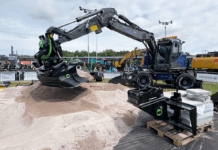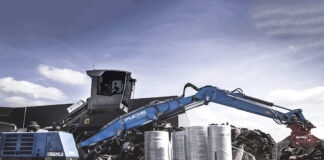
How can critical aggregate materials – gravel, sand, and crushed stone – be transported into construction hubs like London, as quickly and cleanly as possible? Rail logistics specialist DB Cargo UK has partnered with Liebherr Great Britain and Siemens Financial Services to acquire modern, efficient material handlers for loading and unloading aggregates travelling by rail.
The UK’s construction industry relies on thorough logistical planning. Whether for plant, machinery or materials, meeting deadlines relies on deliveries being made in the right order and at the right time.
In London, this comes with unique challenges. With a huge volume of building projects underway at any given period, there is pressure on material suppliers to have volumes of raw materials available, at the times and in the places required.
Core to the industry is the supply of aggregates, both in raw form and for use in ready mixed concrete production. London is a long way from most of the hard rock quarries in the UK, with many suppliers opting to remove road transport from the equation by operating dedicated rail services into the periphery of the city.
Rail services allow aggregate suppliers to deliver in bulk, keeping material costs down, but also significantly reducing carbon footprint, removing potentially hundreds of daily truck movements.
Reliable loading and offloading
| “We have been purchasing Liebherr material handlers for many years and find them to be an ideal machine for our operations. Liebherr Great Britain works very closely with us to deliver the machines optimally suited to our needs allowing us in return to work as effectively as possible, handling a variety of construction materials.”
Selaudin Vata, Operations Terminal Manager, DB Cargo |
One of the UK’s leading advocates of rail transport and material handling services is DB Cargo UK. As part of Germany’s DB Schenker Group, DB Cargo UK is one of the UK’s largest rail freight companies, transporting everything from cereals to coal, barbecues to biomass, and petroleum to steel.
Handling over 36 million tonnes per year, DB Cargo UK employs more than 2,200 people in its UK business and uses almost 230 diesel and electric locomotives to efficiently haul its range of cargoes across the country.
As well as offering customers a reliable and cost-effective service to take materials from A to B, the company also provides a loading and offloading service, using modern, fuel efficient and reliable material handling machines.
To maintain this service, DB Cargo UK operates a large fleet of Liebherr material handlers, with a batch of seven new LH 40 models arriving at a selection of depots in the past few months.
Changeover at Cricklewood
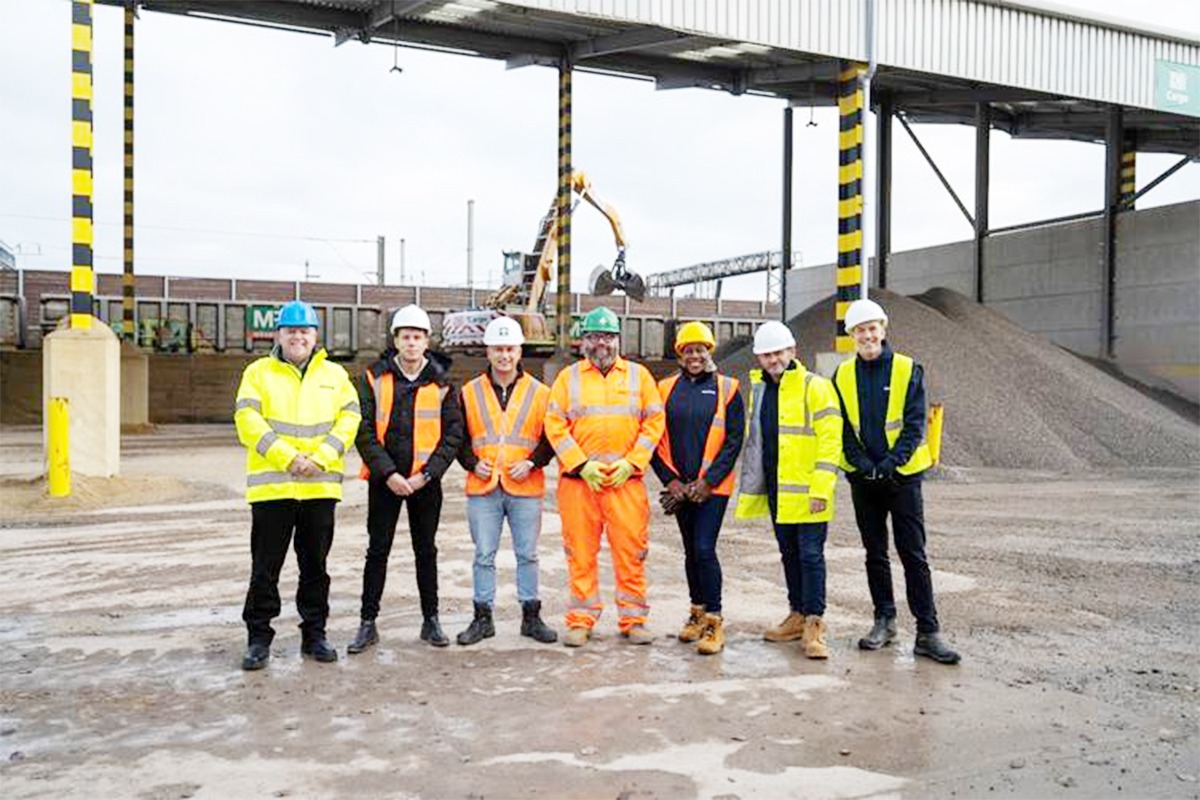
One of the latest arrivals, an LH 40 C, has been put to work at the company’s Cricklewood depot in North London. The 151-hectare site opened in 2020 and was designed to be the UK’s first ‘net zero’ rail freight terminal.[i]
Among its features are a large green acoustic barrier (in essence, a wall of earth) to minimise the impact of noise and dust on nearby homes, and to provide a haven for birds and other wildlife. On-site machinery is fuelled by Hydro-treated Vegetable Oil (HVO) instead of white diesel, reducing CO2 emissions by 98% per litre. The new Liebherr material handlers are also HVO-compatible.
The depot is permitted to handle 500,000 tonnes of material annually and in recent years it has regularly done so. This volume is made up of both incoming aggregates and the export of inert soils to landfill.
| “With the LH 40, the whole process of unloading close to 1,000 tonnes of aggregates takes just over two hours in total and removes over fifty 8-wheelers off the roads from Somerset to London.” |
Despite uncertainty in the construction market, the site remains a busy place with a steady stream of trucks coming in to be loaded. One of the UK’s leading aggregate suppliers, Whatley Quarry in Somerset, sends over half of its output via the rail network, reducing congestion, cost and carbon impact.
With the LH 40, the whole process of unloading close to 1,000 tonnes of aggregates takes just over two hours in total and removes over fifty 8-wheelers off the roads from Somerset to London. Additionally, the LH 40 is economical to run, using just over 13 litres of fuel per hour – up to 20% less than previous models. The modern handlers improve uptime, and are expected to run at almost full capacity, with 85–90% use across DB Cargo UK’s depots.
Under the surface – financing the investment
The Liebherr material handlers represent a significant investment, and many companies would shy away from talking about how they finance such a purchase. This is not the case with DB Cargo UK. Siemens Financial Services (SFS), a specialist financier with knowledge of construction equipment, provided an £8.5m revolving credit line to finance the acquisition of the LH 40 machines.
Selaudin Vata shares, “Mark Franklin at Liebherr Great Britain introduced us to John Kennedy at SFS, to help build a finance structure supporting DB Cargo UK’s fleet replacement programme across multiple construction terminals. We couldn’t be happier with the outcome.”
Under the terms of this solution, DB Cargo UK can lease the equipment for up to five years, benefiting from a 12-month drawdown window for each delivery. This means that the company only begins payment following delivery of a material handler, aligning machine costs with income from customer contracts.
For even further flexibility, the solution allows DB Cargo UK to smooth VAT payments across the financing period. SFS’ expert Asset Management Specialists expect an advantageous resale value of the equipment at the end of the leasing term, reducing DB Cargo UK’s monthly payments. As for Liebherr, this financial solution facilitated a multi‑unit order, further aided by pre-approved, standardised documentation and processes.
[i] DB Cargo UK, Cricklewood becomes ‘UK’s first net zero rail freight terminal’,