
How much it costs you not to recover rebar
Recovering steel directly on site: the single cycle that compresses time, costs and operational steps.
Demolition sites have a critical point that rarely appears in quotations yet directly affects margins: reinforcing steel, or rather, how it is managed.
When the process multiplies costs.
For years, reinforced concrete treatment has been based on a fragmented sequence: demolition, transport, crushing and steel separation at external plants. A long, costly and logistically complex timetable that brings extended timeframes, multiple handling stages and a gradual loss of material value.
When you look at sites where reinforced materials are the norm, this setup directly impacts contract profitability.
A single operation instead of three
MB Crusher proposes a different approach: with a jaw crusher fitted with a 24 V iron separator, demolition materials can be crushed and steel recovered directly on the spot, reducing numerous stages to just one.
Production wise, there are two distinct streams: reusable clean aggregate and recovered steel which is destined for the recycling chain. This is not about adding another machine, but about eliminating unnecessary and costly steps.
European sites: when the single cycle works
In Sweden, one of our clients operating in the demolition sector is processing reinforced concrete using the BF90.3 crusher bucket. The equipment allows material to be crushed directly on the site, while the integrated iron separates the rebar. This way, not only is the material volume reduced, but a reusable quality aggregate is also obtained, turning a problematic material into a tangible resource.
In Arad, western Romania, the demolition of a former industrial mill follows the same logic: none of the present material left the site perimeter. Reinforced concrete was crushed, again using a jaw crusher, separated on site and reused 100%, while the recovered steel became an active balance-sheet item.
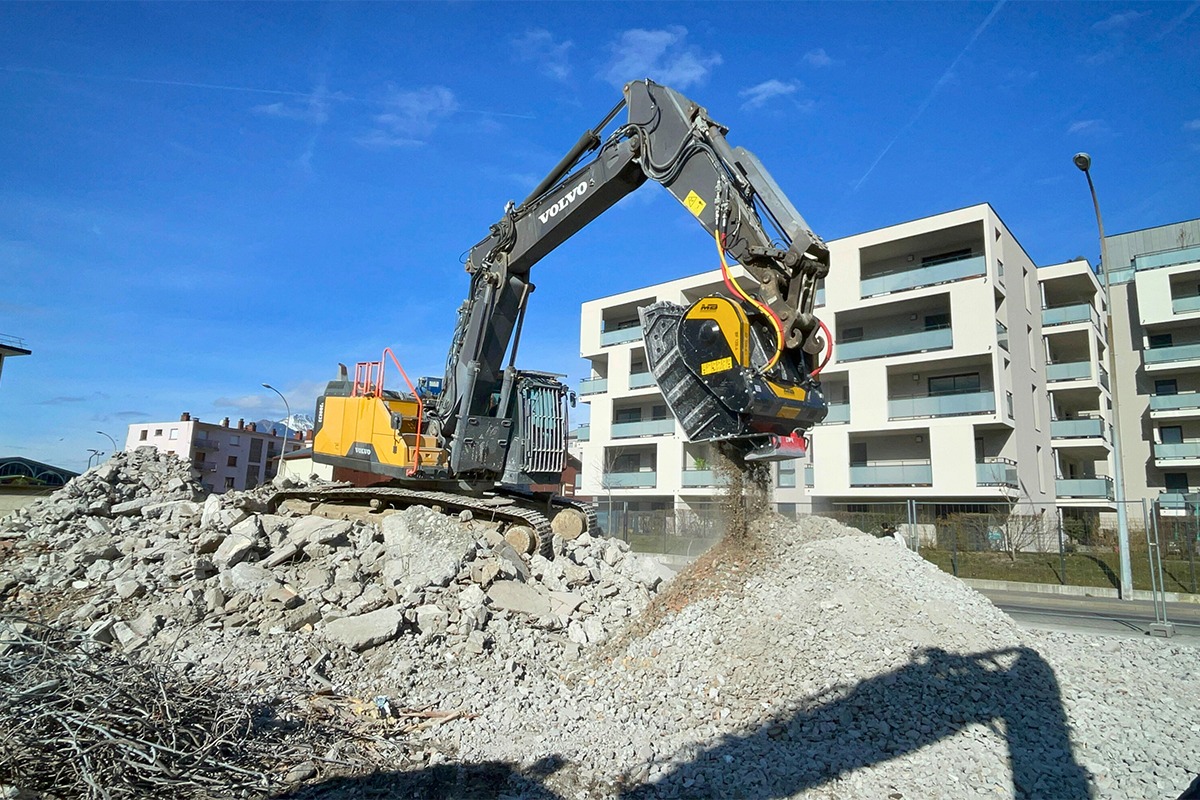
Finally, in Alta Savoia, on a residential site with limited space, the single cycle made it possible to avoid transport and intermediate stages. The material crushed by a BF120.4 crusher bucket, cleared of ferrous components, was immediately reused for preparing new foundations.
Recovering steel to protect margins and timelines
Separating steel at the very moment the material is processed means drastically shortening timeframes while preserving the quality of recycled aggregate. The crushed material remains on site, ready to be reused. Scrap metal, meanwhile, becomes a resource that can be monetized. The advantage is not only environmental, but also operational and economic.
From technical choice to operating standard
In a market where time and margins are increasingly compressed, the difference is not made by those who move more, but by those who eliminate superfluous steps. Recovering steel directly on site is becoming an operating standard for companies that want to maintain control over costs and timing.
Today the question is no longer whether to recover scrap metal.
The question is: how much does it cost not to.